
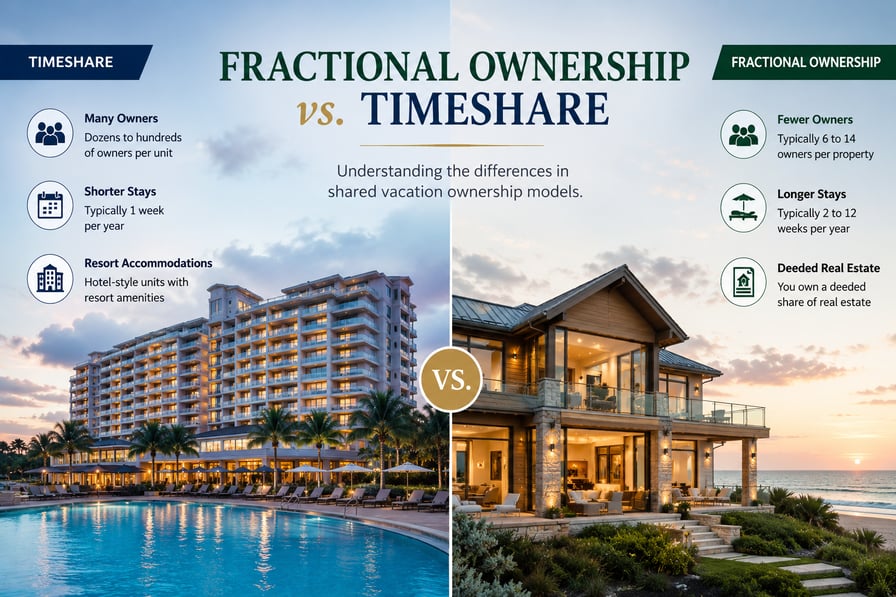
For decades, shared vacation ownership has offered travelers a way to enjoy premium destinations without the full cost and responsibility of owning a second home. Two of the most common models are timeshares and fractional ownership. While the terms are sometimes used interchangeably, they represent very different ownership structures, investment considerations, and guest experiences.
Understanding the distinction is important whether you're considering ownership, evaluating resort business models, or exploring opportunities in the evolving vacation and hospitality market.
What Is a Timeshare?
A timeshare is a form of shared vacation property ownership that gives multiple individuals the right to use a resort unit, vacation home, or accommodations for a specified period each year.
Rather than purchasing an entire property, owners typically purchase either:
- A fixed week each year
- A floating week that can be reserved within a season
- A points-based interest that can be used across a network of resorts
Timeshares were originally created to make vacation ownership more affordable by allowing multiple owners to share the cost of a property. Many modern programs provide flexibility through exchange networks, points systems, and access to multiple destinations.
Benefits of Timeshare Ownership
- Lower upfront investment than purchasing a second home
- Access to resort-style amenities
- Predictable vacation planning
- Ability to exchange destinations through vacation club networks
- Professional property management
For resort operators, timeshares can create recurring revenue, stronger customer loyalty, and more predictable occupancy patterns.
What Is Fractional Ownership?
Fractional ownership is a shared real estate model that allows multiple owners to purchase a legally deeded interest in a luxury vacation property.
Unlike many traditional timeshare arrangements, fractional owners hold actual real estate ownership and receive a deeded share of the property. Ownership typically provides between two and twelve weeks of annual usage depending on the size of the ownership interest.
In most cases, ownership is divided among a small group of owners—often between six and fourteen parties.
How Fractional Ownership Works
Owners purchase a percentage interest in the property, commonly ranging from:
- 1/4 ownership
- 1/8 ownership
- 1/10 ownership
- 1/13 ownership
The ownership percentage generally corresponds to annual usage rights. Operating expenses such as property taxes, maintenance, utilities, insurance, and housekeeping are shared among all owners.
Professional management companies typically oversee operations, ensuring owners can enjoy the benefits of ownership without the responsibilities of maintaining a second home.
Benefits of Fractional Ownership
Real Estate Equity
Fractional owners receive a deeded ownership interest rather than simply usage rights. Depending on market conditions, the ownership interest may appreciate over time and can often be sold, transferred, or passed to heirs.
Access to Luxury Properties
Fractional ownership often makes high-end beachfront homes, mountain retreats, and luxury resort residences attainable at a fraction of the cost of sole ownership.
Reduced Ownership Costs
Maintenance expenses, taxes, insurance, and upkeep are divided among owners, reducing the financial burden associated with owning an entire vacation property.
Professional Management
Owners enjoy a largely hassle-free experience with cleaning, maintenance, administration, and reservation coordination handled by management professionals.
Premium Amenities
Many fractional ownership programs include access to luxury resort amenities such as:
- Private beaches
- Golf courses
- Marinas
- Spas and wellness facilities
- Fine dining
- Concierge services
- Owner-exclusive events
Fractional Ownership vs. Timeshare
While both models provide shared access to vacation properties, the similarities often end there.
|
Feature |
Timeshare |
Fractional Ownership |
|
Ownership Interest |
Often usage rights |
Deeded real estate ownership |
|
Number of Owners |
Often dozens or hundreds |
Typically 6–14 owners |
|
Property Type |
Resort units |
Luxury homes and residences |
|
Equity Potential |
Limited |
Potential appreciation |
|
Resale Market |
Often challenging |
More similar to traditional real estate |
|
Annual Usage |
Usually 1–2 weeks |
Typically 2–12 weeks |
|
Purchase Price |
Lower |
Higher |
|
Amenities |
Resort-focused |
Resort and luxury residential |
Why Interest in Fractional Ownership Is Growing
Today's travelers increasingly seek larger accommodations, premium experiences, and greater flexibility. Fractional ownership addresses many of these preferences while reducing the financial commitment required to own a luxury vacation property outright.
Advances in technology, reservation systems, owner portals, and property management platforms have also made it easier than ever to administer complex ownership structures, schedule usage rights, manage owner communications, and coordinate financial operations.
As a result, many resort operators, developers, and hospitality companies are revisiting fractional ownership models as a way to create long-term customer relationships while maximizing property value.
Which Model Is Right for You?
The answer depends largely on your goals.
A timeshare may be attractive if you primarily want predictable annual vacations, lower upfront costs, and access to a network of destinations.
Fractional ownership may be a better fit if you desire a true ownership interest, access to luxury real estate, longer annual usage periods, and the potential benefits associated with real estate ownership.
Both models continue to evolve, offering travelers more ways than ever to enjoy exceptional vacation experiences without the costs and responsibilities of sole ownership.
Whether you're considering ownership, developing a resort program, or exploring new hospitality opportunities, understanding the differences between fractional ownership and timeshares is the first step toward making an informed decision.
Managing Fractional Ownership and Timeshare Operations Requires the Right Foundation
While travelers often focus on the ownership experience, operators and developers know that the real challenge happens behind the scenes.
Fractional ownership and timeshare programs introduce unique operational and financial complexities. Managing ownership schedules, reservation rights, owner communications, contracts, maintenance fees, recurring assessments, guest stays, housekeeping, reporting, and owner distributions requires far more than a traditional reservation system.
That's where purpose-built property management technology becomes critical.
At Barefoot, we help hospitality companies, resorts, vacation rental operators, and ownership-based lodging businesses manage the operational and financial complexity that comes with shared ownership models. Our flexible platform supports multiple stay types, complex ownership structures, owner portals, online payments, eSignatures, reporting, and industry-leading trust accounting capabilities designed to handle sophisticated financial workflows.
Whether you're operating a traditional timeshare program, a luxury fractional ownership community, mixed-use resort accommodations, or a combination of short-, mid-, and extended-stay inventory, the goal remains the same: deliver an exceptional owner and guest experience while maintaining complete financial visibility and control.
As shared ownership models continue to evolve, operators need technology that can adapt with them. Barefoot provides the flexibility, accounting foundation, and partnership approach needed to support today's hospitality businesses—and the ownership models of tomorrow.
Exploring Fractional Ownership or Timeshare Operations?
See how Barefoot helps operators manage complex ownership structures, reservations, owner communications, and financial operations—all on a single platform.


